

MMarcus Webb
The daily question gave my morning reading a little direction.
09/30/2026


“Always be prepared to give an answer to everyone who asks you to give the reason for the hope that you have.”
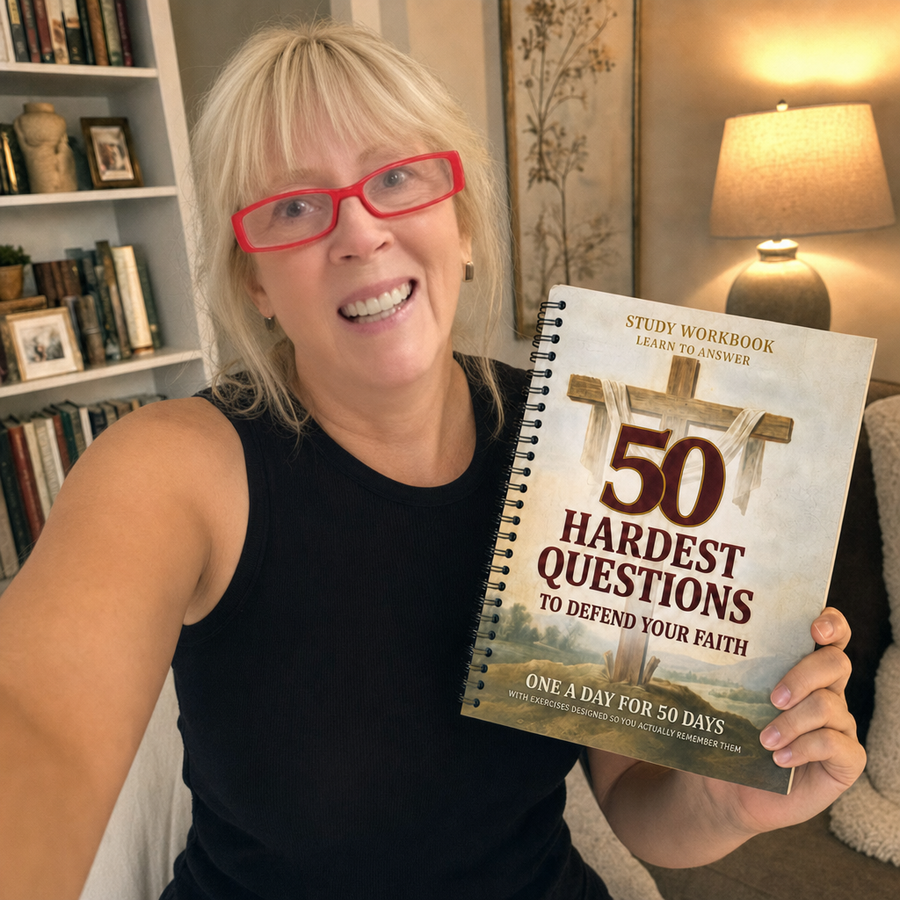
One question a day for 50 days — with exercises built so the answers actually stay with you
Written for every Christian tradition · No “lost books” · Never a substitute for the Bible you already read
No particular one on purpose. The evidence (manuscripts, dates, archaeology, the text itself) is common ground for every Christian tradition. Wherever an answer would mean siding with one camp, we say so openly instead of quietly choosing.
No. No banned books, no suppressed texts, no secrets anyone is hiding from you. Every claim comes with a source you can check for yourself and where the evidence is thin, it tells you so rather than dressing it up.
It doesn’t replace your Bible and never tries to. It covers what your Bible doesn’t tackle head‑on: where the text came from, why these books were included, and what history outside it really shows.

You already believe. No one ever handed you the reasons.
So when your brother‑in‑law asks how you know the Bible wasn’t simply voted into existence at some council, you feel it — that half‑second where you realize you have no answer. Not doubt. Just a blank.
This fixes that. One question a day for 50 days: the question, the case behind it, and exercises that make you write the answer in your own words. Because reading an answer and being able to give one are two different things.
Every question gets the same 5 angles. What Scripture says. What the manuscripts and history really show. Whether the argument holds. What a thoughtful skeptic says back. And the one sentence you’ll still remember six months from now.
Some of the 50 will come from other people. Your coworker. Your daughter, back from her first semester. The friend who started posting things that worry you.
Some of the 50 are your own. The ones you’ve never said out loud — not in small group, not to your pastor, not to anyone.
They get the same treatment either way. They were always the same question.
Each of the 50 lessons follows the same 5 steps. No question gets a thin answer, and none get skipped.
What the text itself says, with the references right beside it so you can check each one in your own Bible.
Manuscripts, dates, archaeology, sources outside the Bible — and, just as important, an honest note wherever the evidence stops.
Whether the argument holds up on its own terms, explained plainly, with no philosophy degree required.
What a thoughtful skeptic says back — and how your answer stands up. Hardly anyone teaches this step, yet it’s the one that decides the conversation.
The short version you’ll still have at the dinner table. You write it yourself, in your own words — which is exactly why it sticks.
That’s not a discipline problem, and it’s not a sign of weak faith. It’s simply how listening works. When you watch someone else answer well, your brain files it as familiar — and familiar feels a lot like known. That feeling only breaks when someone asks you directly and nothing comes out.
Watching builds recognition. Answering takes recall, and they’re not the same thing. Recall is built by reading it and writing it down, in your own words, with no video playing. That’s the whole difference between the 40 hours you’ve already put in and the 15 minutes a day this asks of you.
Built around the questions that come up most in public debates, campus Q&As, and the comment sections below them.
The question sits at the top, and everything below it builds the case for the answer — in the order you’d actually need it, so you can read it once and find your way back later without searching.
We built it that way because of how a book like this really gets used. No one reads apologetics cover to cover. You reach for it when something comes up. So each question had to stand alone: you open to it, and everything you need is right there on those two pages.
What Scripture says. What the history and manuscripts show. Whether the argument holds together on its own terms. What a skeptic would say back. And a short version you can actually say out loud.
They always appear in the same order, which sounds minor and isn’t. After a week or two you stop hunting for where things are and simply read. And because the shape never changes, you start to see which angle you’re weakest on — usually not the one you’d guess.
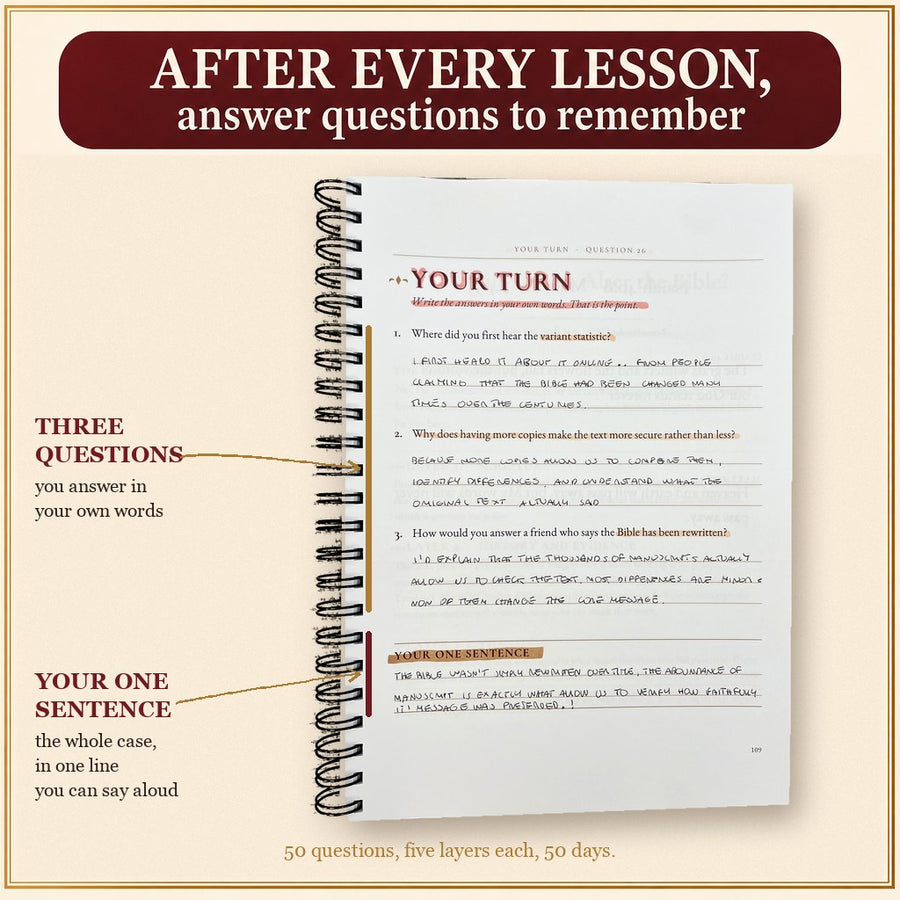
The last page of each lesson is where the work happens. It explains nothing. It asks you to write the answer yourself, from memory, in your own words — and leaves you room to do it.
That page exists because of something well established about memory that’s easy to get wrong. Rereading an answer feels productive: it’s familiar, it goes down easily, and you close the book feeling like you’ve got it. But recognizing something isn’t the same as being able to produce it, which is why the answer was gone a week after the last time you looked one up. What really moves it into long‑term memory is having to pull it back out without looking.
That’s the whole reason the last page is blank — and why it feels a bit uncomfortable the first few times. It’s meant to.
Fifteen minutes, once a day, for fifty days. By the end you’re not carrying a book around waiting to look something up. You just have the answers.
And a surprising amount of that comes down to something most Christians are never shown: dates.
“For I delivered to you as of first importance what I also received: that Christ died for our sins… that He was buried, that He was raised on the third day… and that He appeared to Cephas, then to the twelve.”
— 1 Corinthians 15:3‑5
Read that opening line again. Paul isn’t composing it. He’s repeating it. “Delivered… received” is the ancient world’s technical language for passing on a fixed, memorized formula — the way a rabbi handed down a teaching word for word.
Which means the creed is older than the letter it sits in. Paul wrote 1 Corinthians around AD 55, about twenty‑five years after the crucifixion. But he says he received this — and scholars across the spectrum, skeptical ones included, date the creed itself to within a few years of the cross. Some place it inside five.
Legends need time. This one has none. The claim that Jesus died and rose wasn’t a story that grew over generations — it was being recited as a formula while the eyewitnesses it names were still alive to be questioned.
I won’t tell you that settles it. It doesn’t.
Someone can accept every word of that dating and still not believe a resurrection happened. A thoughtful skeptic will tell you exactly that, and they won’t be bluffing.
What it does is move the conversation onto ground you can both stand on. It takes “you just believe an old legend” off the table and puts dates, sources, and what the earliest people actually claimed in its place.
That’s what all 50 questions are designed to do.
And this one isn’t unusual. The same kind of thing is sitting in plain sight everywhere:
Most Christians go their whole lives without ever being given this. Not because their faith is weak. Because no one ever sat them down and walked them through it.
You can keep believing it without the reasons.
Or you can spend 15 minutes a day and finally have them.
 50 QUESTIONS · 5 ANGLES EACH · 250 ANSWERS
One question a day. 5 angles each. Exercises that make it stick. The same faith you already have — now with the reasons attached.
30‑day money‑back guarantee. Work through the first 10. If you don’t feel steadier than when you began, email us and keep your copy.
The daily question gave my morning reading a little direction.
09/30/2026I finally slowed down enough to put my beliefs into my own words.
09/30/2026The exercises helped me notice where my explanations got fuzzy.
09/29/2026My husband and I have enjoyed comparing our answers over coffee.
09/29/2026Easy to start and surprisingly thoughtful once you get into it.
09/28/2026I like having one clear question to focus on instead of ten.
09/28/2026This made a good companion to my personal Bible study.
09/27/2026The format kept me coming back even during a busy week.
09/27/2026I felt more comfortable admitting which questions I still had.
09/26/2026A useful starting point for conversations with my teenage daughter.
09/26/2026The writing felt approachable without talking down to me.
09/25/2026I appreciated the chance to think before trying to answer anyone else.
09/25/2026Small daily steps worked much better for me than a long weekend reading session.
09/24/2026I found myself revisiting my written answers later in the week.
09/24/2026Our group had a thoughtful discussion after working through a question together.
09/23/2026This helped me turn scattered thoughts into a clearer explanation.
09/23/2026The exercises are the part I keep thinking about afterward.
09/22/2026I enjoyed reading a little and then actually doing something with it.
09/21/2026A manageable way to make reflection part of my routine.
09/21/2026I have been taking my time, and the structure really suits me.
09/20/2026Good questions and a format that feels easy to stick with.
09/20/2026I was looking for a place to begin, and this gave me one.
09/19/2026My sister and I are working through it at our own pace.
09/19/2026The daily approach helped me stop putting off difficult subjects.
09/18/2026I liked being encouraged to explain an answer instead of just recognizing it.
09/18/2026It has given my evening reading a useful focus.
09/17/2026The tone made me feel comfortable bringing my questions to the page.
09/17/2026I am learning to pause before jumping into a discussion.
09/16/2026There is something satisfying about finishing one question thoughtfully.
09/16/2026The workbook approach fits the way I learn.
09/15/2026I have enjoyed writing my answers and seeing how they change.
09/15/2026This sparked a conversation with my dad that I am glad we had.
09/14/2026The bite-sized routine was exactly what I needed to get started.
09/14/2026I appreciate a book that leaves me thinking after I close it.
09/13/2026Working through the exercises helped the ideas feel more personal.
09/12/2026It gave me a reason to set aside a few quiet minutes.
09/12/2026I do not feel rushed to have every answer immediately.
09/11/2026This has been a helpful addition to our weekly study time.
09/11/2026I like the balance between reading and reflecting.
09/10/2026The questions helped me identify what I wanted to study further.
09/10/2026I started alone and invited a friend to join me.
09/09/2026The daily structure made a big topic feel approachable.
09/09/2026I have been more deliberate about listening during faith conversations.
09/08/2026Putting my thoughts on paper was more helpful than I expected.
09/08/2026A good fit for someone who enjoys learning a little at a time.
09/07/2026I keep coming back to the exercises instead of simply turning the page.
09/07/2026My wife and I have had some meaningful conversations alongside this.
09/06/2026The format helped me build a consistent reading habit.
09/06/2026I liked having a specific purpose each time I sat down.
09/05/2026This gave our small group a comfortable place to begin talking.
09/05/2026I found the everyday pace encouraging.
09/04/2026It helped me notice the difference between repeating an answer and understanding it.
09/03/2026I enjoyed being able to revisit a question without starting the whole book again.
09/03/2026The reflection time has become my favorite part of the day.
09/02/2026I am glad I chose something I could work through gradually.
09/02/2026A thoughtful resource for organizing what I believe.
09/01/2026I have been using the questions as a starting point for journaling.
09/01/2026My college-age daughter and I enjoyed comparing our perspectives.
08/31/2026The exercises encouraged me to slow down and be specific.
08/31/2026I appreciate the focus on remembering what you have read.
08/30/2026This helped me get past staring at a blank journal page.
08/30/2026One question gives me plenty to think about on my daily walk.
08/29/2026I found it easy to pick up again after missing a day.
08/29/2026The routine feels practical for a busy household.
08/28/2026I liked being able to study on my own before talking with others.
08/28/2026It has made my reading time feel more intentional.
08/27/2026The prompts helped me find words for thoughts I had never written down.
08/27/2026I enjoyed the steady pace from one day to the next.
08/26/2026A helpful way to begin exploring questions I had been avoiding.
08/25/2026I have been sharing my reflections with a close friend.
08/25/2026The book gave me a little structure without overwhelming my schedule.
08/24/2026I liked that the exercises asked me to participate.
08/24/2026This works well alongside the notes I already keep.
08/23/2026I feel better prepared to have a calm conversation about my faith.
08/23/2026A satisfying change from passively reading and forgetting everything.
08/22/2026I look forward to seeing what the next question makes me consider.
08/22/2026My brother and I have been checking in about our progress.
08/21/2026I appreciate being able to linger on a question when I need to.
08/21/2026The workbook gave me a clear next step each day.
08/20/2026I found the approach welcoming as someone getting back into study.
08/20/2026This helped me make room for questions instead of pushing them aside.
08/19/2026I enjoyed looking back at how I answered earlier in the book.
08/19/2026The daily rhythm has been easy to maintain.
08/18/2026I have used a few of my written reflections to start family conversations.
08/18/2026The simple structure lets me focus on the ideas.
08/17/2026It has been useful for reviewing things I thought I already understood.
08/16/2026I like having something concrete to work on during quiet time.
08/16/2026The questions stayed on my mind long after the reading was done.
08/15/2026A friend and I are taking it slowly, and it has been worthwhile.
08/15/2026I found the exercises a helpful check on my own understanding.
08/14/2026This gave my study routine a fresh sense of purpose.
08/14/2026I appreciate a format that makes room for my own words.
08/13/2026The short daily focus feels inviting even when I am tired.
08/13/2026I am glad I worked through the questions instead of rushing ahead.
08/12/2026It has helped me approach discussions with more patience.
08/12/2026The book fits nicely into my early morning routine.
08/11/2026I have enjoyed setting aside one question for each evening.
08/11/2026A good resource for building a habit of thoughtful reflection.
08/10/2026I found myself talking about the day's question at dinner.
08/10/2026The exercises gave me a reason to read more carefully.
08/09/2026I liked revisiting an answer after letting it sit overnight.
08/08/2026This helped me take my own questions seriously.
08/08/2026The pacing made it easier to stay engaged.
08/07/2026It has been a useful conversation starter with my spouse.
08/07/2026I feel more organized when I explain what I believe.
08/06/2026I enjoyed having a goal that felt achievable day by day.
08/06/2026The workbook format kept me involved in the material.
08/05/2026This gave me something meaningful to focus on during lunch breaks.
08/05/2026I liked the way one question could lead to deeper personal reflection.
08/04/2026My study partner and I have enjoyed talking through our responses.
08/04/2026The daily approach helped me avoid trying to do everything at once.
08/03/2026I have been keeping my answers so I can return to them later.
08/03/2026A practical addition to the time I already spend reading Scripture.
08/02/2026I was surprised by how much I enjoyed the written exercises.
08/02/2026This helped me develop a steadier study routine.
08/01/2026I appreciated being able to work through it without a group.
07/31/2026It gave me a framework for conversations I used to find awkward.
07/31/2026The questions invited reflection that felt relevant to my life.
07/30/2026I like coming away with something I have actually thought through.
07/30/2026My mother and I have enjoyed discussing our daily responses.
07/29/2026The format made it easier to begin than I expected.
07/29/2026I found value in putting familiar ideas into plain language.
07/28/2026It has helped me be more thoughtful with the words I use.
07/28/2026The exercises turned reading time into active study for me.
07/27/2026I enjoyed the sense of progress from completing each day.
07/27/2026This has become a regular part of my Sunday reflection time.
07/26/2026I like that I can revisit my own answers as well as the reading.
07/26/2026A helpful way to prepare for respectful discussions.
07/25/2026I have been taking notes I actually want to read again.
07/25/2026The daily focus kept my attention from wandering.
07/24/2026This encouraged me to ask better follow-up questions.
07/24/2026I enjoyed working through the material with a notebook beside me.
07/23/2026The structure helped me stay consistent without making study feel complicated.
07/22/2026I came away with a clearer sense of what I want to keep learning.
07/22/2026Finishing the daily exercise always feels like time well spent.
07/21/2026Helpful content. I wish the daily headings were a little bolder for quick browsing.
07/21/2026I enjoyed the exercises; I would personally prefer a simpler cover design.
07/20/2026Good study companion. I wish the day numbers stood out a bit more.
07/20/2026The daily format works for me. A small progress checklist would be a nice touch.
07/19/2026Worth working through. I prefer numbering my notes, so I added my own system.
07/19/2026Thoughtful questions. I would have liked a dedicated place to write my start date.
07/18/2026I like the material; my only wish is a more understated title treatment.
07/18/2026Useful for our discussions. A little completion box beside each day would suit me.
07/17/2026Good workbook overall. I wish there were an optional spot to record a study partner's name.
07/17/2026The reading routine is enjoyable. I would choose a different accent color if I could.
07/16/2026I found it helpful. A simple end-of-week check-in marker would be convenient.
07/16/2026A solid addition to my study time. I like wider spacing around headings.
07/15/2026The questions gave us plenty to discuss. I wish the title were shorter to write in my journal.
07/15/2026Happy with the content. My preference would be a minimal, text-only cover.
07/14/2026I enjoyed the daily exercises. An optional date field for each session would be handy.
07/13/2026Good for a steady routine. I wish there were a small place to note when I revisited a day.
07/13/2026Helpful and approachable. I would personally choose less decorative styling.
07/12/2026I liked working through it. A simple halfway-point marker would be a fun addition.
07/12/2026The content worked well for me. I wish I could choose between a couple of cover colors.
07/11/2026A worthwhile read. I like to track study time, so a little timer field would suit my habits.
07/11/2026Good questions and useful exercises. A spot for my initials after each day would be convenient.
07/10/2026I have enjoyed using it. My only preference is for more prominent section labels.
07/10/2026A helpful workbook. I wish there were a small space for a personal dedication.
07/09/2026The daily approach is good. I would enjoy an optional completion-date box at the end.
07/09/2026Good product with thoughtful exercises. I realized I prefer reading several questions at once, so the daily routine was only an average fit for my habits.
07/08/2026The material is helpful. I personally enjoy discussing ideas out loud more than writing responses, so I liked the reading more than the workbook routine.
07/08/2026No. Plain English all the way through, and when a technical term can’t be avoided, it’s explained the first time it appears. If you can read your Bible, you can do this.
About 15 minutes. Read the question, work through the 5 angles, do the exercises. If a question grabs you, stay with it longer but 15 minutes is enough to finish the day properly.
Nothing happens. No streaks to break, nothing to catch up on. Pick it back up whenever you next have 15 minutes; the questions don’t depend on each other to make sense.
Yes, and it works well that way. Since everyone writes their own answers, there’s something real to compare when you meet and the one‑sentence versions are usually where the best conversations start.
Adults. The language is plain, but the questions aren’t watered down, and the evidence sections go into real detail. Older teens who are already asking these questions do fine with it.
Work through the first 10 questions. If you don’t feel steadier than when you began, email us within 30 days for your money back and keep your copy.
You’ll receive your order confirmation by email right after purchase, followed by an email with your delivery details. Can’t find it? Check your spam folder or contact support@truepagez.com and we’ll help you out.